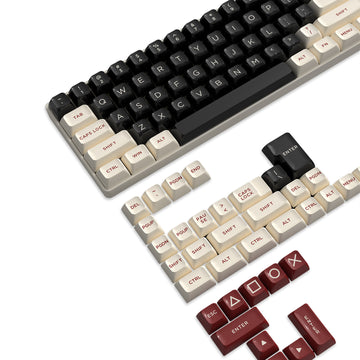
Double-shot PBT keycap legends resist fading because the letters and symbols are molded plastic, not printed ink sitting on top of the keycap. In a printed keycap, the character is a thin surface layer that ordinary finger contact can gradually wear down. In a double-shot keycap, the character is a separate piece of plastic joined to the keycap body during manufacturing, so there is no ink layer for typing to rub away.

That difference matters most for anyone typing or gaming for hours a day on mechanical keyboards, where the same keys get pressed thousands of times. It does not mean a double-shot legend is immune to every kind of damage. The rest of this guide breaks down why printed legends wear, how the molding process actually works, what the PBT material label does and does not prove, and how to check a listing before you buy.
Why Keycap Legends Wear
Printed keycap legends wear because the character is ink sitting on the keycap surface, and repeated finger contact can slowly abrade it away. Most budget keycaps use pad printing, a process where a soft rubber pad transfers ink from an etched plate onto the finished keycap. It is cheap and flexible, which is why it shows up on so many stock mechanical keyboards.

The problem is durability. Pad-printed ink wears through repeated contact and abrasion, and manufacturers often add a clear protective coating over the ink to slow that process down. A coating buys time, but it does not remove the underlying issue: the legend is still a surface layer, and surface layers thin out with use.
Double-shot construction changes what your finger actually touches. Instead of ink on top of plastic, the legend itself is molded plastic that sits flush with, or runs through, the keycap structure. Ordinary typing contact reaches solid polymer instead of a removable coating. That is the core reason double-shot legends hold up better under everyday use, though it is a resistance to one specific wear mechanism, not a blanket guarantee against all damage.
How Double-Shot Injection Molding Builds the Legend
Double-shot injection molding builds the legend in two separate molding stages instead of printing it on afterward. The name refers to the two-step manufacturing process, not just the fact that the keycap uses two colors.
In the first step, the character or symbol is molded on its own from a solid piece of plastic. This creates a small plastic insert shaped exactly like the legend. In the second step, that insert is placed into a different mold, and additional plastic is injected around it under heat to form the rest of the keycap body. The two moldings fuse into one solid piece, with the legend plastic and the body plastic sitting side by side rather than one layer on top of the other. This is documented as a two-step molded-plastic process where the legend insert from the first shot becomes a structural part of the finished keycap.
Because the legend is formed this way, it reaches the same height as the surrounding keycap material. There is nothing printed on top to scratch off. A worn key from years of typing will show the same molded character, just with the surface finish of the plastic slightly changed by long-term contact, rather than a faded or missing letter. That structural difference is what separates "double-shot" as a manufacturing claim from ordinary color combinations that just look similar in photos.
What PBT Contributes—and What It Does Not Prove
PBT is the plastic used to make many keycaps, and it contributes its own set of material properties that are separate from how the legend was made. Knowing what PBT does, and does not, tell you helps you avoid assuming every PBT keycap has a molded legend.
What PBT Can Contribute
PBT, or polybutylene terephthalate, is a stiff, semi-crystalline plastic known for surface hardness and chemical resistance, along with low creep and dimensional stability. In a keycap, those properties can translate to a surface that stays matte longer and resists the shine that builds up on some plastics with repeated finger oil contact. These are polymer-level characteristics, not results from testing a finished keycap.
Why PBT Is Not Proof of Double-Shot Legends
PBT describes the plastic. Double-shot describes how the legend was formed. A keycap can be made from PBT and still have a printed legend, because the material choice and the legend-making process are two independent decisions a manufacturer makes.
That means a listing that only says "PBT" has told you about the body material, not the legend. If you want the print-wear resistance that comes from molded legends, check for both facts separately: confirm the plastic is PBT, and confirm the listing specifically states double-shot or double-injection construction. Treating one claim as proof of the other is where buyers get surprised later.
Pad-Printed Versus Double-Shot Keycaps
The practical choice comes down to what your fingers actually contact and how much that matters for your use case. The table below lines up the two constructions on the same three points.
| Construction | What ordinary contact acts on | Best-supported buyer implication |
|---|---|---|
| Pad-printed | Surface ink layer, sometimes topped with a clear coating | Choose this when lower manufacturing cost or flexible, detailed multicolor art matters more than long-term legend wear |
| Double-shot | Molded plastic legend integrated into the keycap body | Choose this when minimizing ordinary print-wear on frequently typed keys is the priority |
If you're typing or gaming for long sessions on mechanical keyboards and want legends that stay readable without relying on a coating, verified double-shot construction is the narrower, better-supported choice for resisting that specific wear pattern. Pad printing still has a place when a set needs elaborate colors or a lower price point, since ink can produce detail that a two-shot mold cannot easily replicate.
How to Verify Double-Shot PBT Before You Buy
You can verify a double-shot PBT claim in three steps: read the exact wording in the listing, look at supporting photos when available, and confirm the material and the construction as two separate facts.
Read the Legend-Process Wording
Look for the words "double-shot," "double injection," or an equivalent phrase that names the molding process itself. Words like "PBT," "durable," or "non-fading" on their own describe the material or make a durability claim, but none of them confirm how the legend was actually made.
Use Photos as Supporting Evidence
Close-up or underside photos can show two distinct molded colors meeting at a clean edge, which is consistent with a molded insert rather than printed ink. This is supporting evidence, not certainty, since photos cannot show you the internal mold geometry a manufacturer used.
Confirm Material and Construction Separately
Once you've checked the process wording and any available photos, confirm the material claim on its own. Our ATTACK SHARK double-shot PBT set is one example of a listing that states both facts directly: the specification sheet identifies the material as double-color injection-molded PBT and separately confirms double-shot construction for the full 149-key set. We treat that kind of listing as a useful reference point for what complete verification looks like, not as proof that every PBT keycap on the market shares the same construction.
If a listing omits the molding method or only mentions PBT, ask the seller for underside photos or explicit double-injection specifications before buying, or choose a fully documented set to ensure your mechanical keyboard gets true molded-legend wear resistance.
FAQs
Can double-shot keycap legends still wear out or become damaged?
Yes, in ways unrelated to the print-wear mechanism that double-shot construction is built to resist. The molded legend removes the surface ink layer that ordinary pad-printed keys can rub away, but it does not protect against scratches, chips, discoloration from spills, or a poorly executed mold. Treat "never fade" as shorthand for resistance to ordinary surface-print wear, not a guarantee against every form of physical damage, and still confirm the double-shot claim before you buy.
Does a PBT keycap label automatically mean the legends are double-shot?
No. PBT identifies the polymer used for the keycap body, while double-shot describes the two-stage molding method used to form the legend. A manufacturer can produce PBT keycaps with pad-printed or surface-applied characters, so you must verify both the PBT material and the double-shot molding process independently in the product specifications.
How can you tell if a keycap is truly double-shot from the underside?
Looking at the underside of the keycap typically reveals two distinct molded plastic colors and the nested insert geometry where the legend was formed in the first injection step. If the underside is a single uniform color and the legend only appears on the top surface, the character was applied with surface ink rather than two-layer injection molding.